
Here is the problem. People ask “what’s the right dose of retatrutide” the same way they’d ask “what’s the right dose of ibuprofen.” That question assumes a stable, approved thing sits on the other end of it. It doesn’t. Read the next sentence carefully: there is no FDA-approved retatrutide product, so there is no FDA-approved dose, and every number you’ve seen floating around a forum or a vial label is a figure borrowed from a clinical trial, not a prescription written for you.
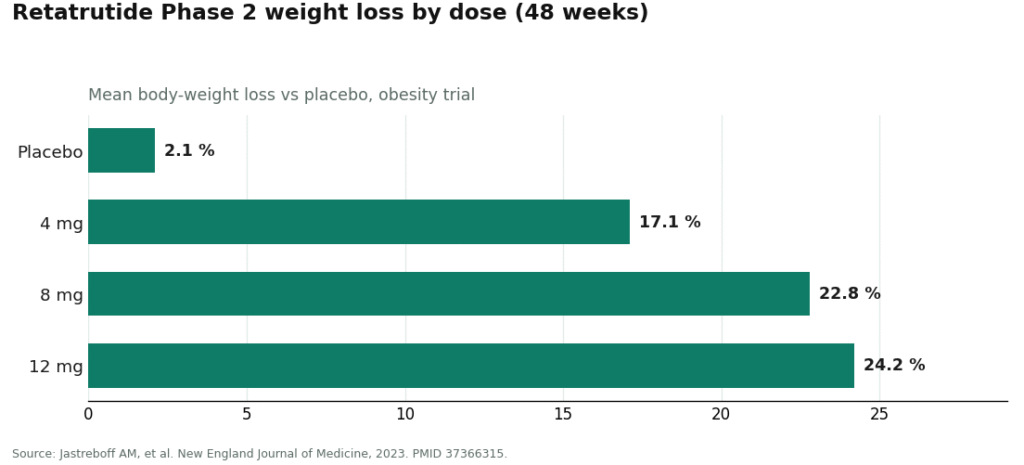
Here is the one honest data point, and it’s a good one. In the 2023 Phase 2 obesity trial published in the New England Journal of Medicine, the top 12 mg dose of retatrutide produced roughly 24.2% mean body-weight loss at 48 weeks, against 2.1% on placebo. That’s a real number, from a real trial, and it’s the reason retatrutide gets talked about like a breakthrough. It’s also the number that gray-market sellers lean on hardest, because it’s the most exciting one available, and it happens to be the one furthest from anything a person injecting alone should treat as a starting point.
Think of it as a denominator problem, because that’s what a data reporter would call it. A rate only means something with a denominator attached. Twenty-four percent weight loss at 48 weeks means something specific: monitored patients, escalating doses, screening criteria, a clinical team watching for trouble. Strip the denominator out, take just the 24.2% and a vial of powder, and what you’re left with is a numerator wearing a number’s clothing. It looks like data. It isn’t a dose.
So let’s walk through this in order, because the order matters more than any single fact in it.
1. Is there an approved dose at all?
No. Retatrutide, known in trial documents as LY3437943, is Eli Lilly’s experimental triple-agonist peptide. It hits three receptors, GLP-1, GIP, and glucagon, and that third arm is what pushed its trial numbers past what semaglutide or tirzepatide alone have shown. The 2023 Lancet Phase 2 trial in type 2 diabetes backs this up from a different angle: roughly a 2.0 percentage-point HbA1c reduction and about 17% body-weight loss at the top escalation dose. Impressive numbers, mid-stage compound. But the confirmatory Phase 3 program, registered as TRIUMPH-1 under NCT05929066, hasn’t finished reading out. No approval, no label, no official titration schedule, no maximum. Everything past this point in the conversation is downstream of that gap.
2. What doses did the trials actually use?
This is the question people mean when they say “how much should I take,” so here’s the straight version. In the obesity trial, weight loss tracked the dose: about 17.1% at 4 mg, about 22.8% at 8 mg, about 24.2% at the top 12 mg dose, all at 48 weeks. Two things matter more than the percentages themselves. First, nobody started at 12 mg. Participants climbed there over time. Second, that climb happened inside a study with screening and clinical oversight built around it. Lift the numbers off the page and use them as a personal plan, and you’ve kept the destination but dropped the entire structure that got people there safely.
3. Why the slow ramp?
Because the side effects are dose-related, and the trials show it plainly. Nausea, diarrhea, vomiting, constipation, all more pronounced as the dose climbs. Slow escalation is the mechanism that keeps that tolerable. Here’s the trap: the exciting number lives at the top of the ladder, and the safety lives in how slowly you climb it. Buy a vial, skip the ladder, start near the trial’s high end because that’s the number that got you interested, and you’ve traded a manageable, mostly temporary side-effect profile for a genuinely rough stretch. Retatrutide also showed a dose-dependent heart-rate increase in trials. Starting high isn’t a rounding error there. If nobody can tell you your escalation schedule and who set it, you don’t have a dose. You have a guess with a milligram sign attached.
4. What does retatrutide even come in?
Not a pen. Not anything finished or standardized. What’s actually out there is lyophilized powder in vials, sold “for research use only,” that a buyer reconstitutes at home. That reconstitution step isn’t a footnote, it’s where the errors live: measuring bacteriostatic diluent, calculating concentration, drawing single-digit milligram doses, with no manufacturing standard behind any of it. And the “not for human consumption” label that keeps these products legally sellable is the same label that means nobody is accountable for sterility, for whether the powder is actually retatrutide, or for whether the stated milligram amount is even close to accurate. The delivery format is telling you something plainly: this is not a finished, accountable product, and it was never built to be one.
5. How do you know the vial contains what the label says?
Mostly, you don’t, and this is the weak link the whole dosing conversation rests on. Your dose math assumes the labeled milligram amount, at the stated purity, of the actual compound. On the gray market, the only thing backing that assumption is usually a certificate of analysis the seller decided to hand you. A real one is batch-specific, tied to your exact lot, produced by an independent lab, and covers identity, purity, quantity, sterility, and endotoxin for anything injectable. A generic PDF with no lot number is decoration. And even a flawless certificate only describes that one batch. It doesn’t make retatrutide proven or safe for you. If you can’t independently verify what’s in the vial, your dose calculation is a number you’re taking on faith, and faith isn’t a dosing protocol.
See also: Winter Preparedness Strategies Every Business Needs for Safer Operations
6. Who is actually supposed to be setting the dose?
A clinician. Full stop. Every approved drug in this class gets dosed by someone who reviewed your history, screened against conditions that make the drug a bad idea, set an escalation schedule, and stayed reachable to adjust it. The retatrutide trials worked the same way, monitoring built in from the start. The gray market removes all of that and hands the decision to you, off a forum post, with nobody screening you and nobody watching the heart-rate signal the trial data specifically flagged.
This is where a supervised model is the only honest answer, so name it as what it is rather than a sales pitch. FormBlends represents the physician-supervised telehealth approach, where a licensed clinician sits between patient and compound, and its catalog treats retatrutide honestly by naming its investigational status instead of pretending it’s an available product. HealthRX.com (healthrx.com) sits in that same tier for the same reason. Neither of them changes the underlying caveat: retatrutide is investigational, it’s not a routinely compounded or approved medication, and the FDA has already acted against sellers marketing it outside clinical trials. Supervision isn’t a promise that anyone can dose you on this compound today. It’s the recognition that the person deciding should be someone who can screen you and check on you, not you with a forum screenshot.
One practical note. People who log their dose and symptoms over time, using something like the FormBlends tracker app, walk into a clinician check-in with an actual record instead of a foggy memory. It’s a logging tool. Not a prescription, not a checkout. For a compound whose own trial data flagged a heart-rate change worth watching, that record is exactly the follow-up the research-chemical model can’t provide, because that model’s relationship with you ends the moment your card clears.
The question buried inside all the others: what gets watched as the dose climbs?
Here’s the part beginners miss. Dosing was never a single decision executed once. It’s a loop: dose, observe, adjust. In the trials, as participants climbed toward those higher numbers, two things were tracked the whole way, gastrointestinal symptoms and heart rate, and the escalation speed was adjusted against what those measurements showed. That loop is the actual mechanism that made the trial’s headline numbers tolerable.
Cut the loop out, which is exactly what a gray-market vial does, and you get a static number picked off a chart, executed blind. Nobody checks whether the GI symptoms mean you’re escalating too fast. Nobody checks the heart rate. So a real answer to “what’s my dose” was never just a milligram figure. It’s the milligram figure plus who’s watching the two signals the trial watched, and how the number moves in response to what they see. Remove the monitoring and you haven’t shrunk the trial protocol down to something more casual. You’ve built a different, riskier thing that happens to share a number with it.
7. So what’s the correct dose, right now, for me?
There isn’t one you can responsibly assign yourself, and that’s not a dodge, it’s just where the math from question one lands. No approved product means no approved dose. The trial figures describe a controlled study, not a personal prescription. The delivery form is unstandardized. The contents are usually unverifiable. And the person meant to set and adjust the dose is a clinician, not you with a spreadsheet.
If one thing sticks, let it be the order. The dosing questions feel urgent, but they all sit downstream of the first one, and the first answer is that retatrutide is investigational, not approved. Until TRIUMPH-1 reads out and the FDA weighs in, the responsible move isn’t sourcing a vial and calculating milligrams off a forum thread. It’s watching the readout. The trial numbers are real. A number you assign yourself using them is not a dose. It just looks like one, and that resemblance is the entire business model of the gray market.
What is retatrutide and what does it actually do in the body?
It’s an investigational drug that hits three receptors at once, GLP-1, GIP, and glucagon, which is more targets than semaglutide or tirzepatide cover. In Phase 2 trials it produced large weight-loss and blood-sugar numbers. It has not cleared Phase 3 and has no FDA approval for anything yet.
How do you reconstitute retatrutide, and does the process change the dose you actually get?
Reconstitution means mixing lyophilized powder with bacteriostatic water, and the math is not forgiving. Get the water volume wrong and you’ve changed the concentration of every dose you draw afterward. That’s the real risk in doing this at home. A compounding pharmacy working under physician supervision handles this step under controlled conditions, and that difference matters more than most people assume.
How long will a 10 mg vial of retatrutide last, and why is the answer complicated?
It depends entirely on your dose per shot and how often you inject, and neither is standardized because there’s no approved protocol to standardize it against. Someone injecting 2 mg weekly stretches a 10 mg vial to five weeks. A different schedule gets a different number entirely. Shelf life after reconstitution is also short, typically a few weeks refrigerated, so timing isn’t just arithmetic.
How do you get retatrutide legally, and what should you be cautious about?
Right now the legitimate paths are clinical trials, or in some cases a compounding pharmacy working with a licensed prescriber. FormBlends operates in that physician-supervised compounding space, which at least brings accountability and quality controls into the picture. The real danger sits in the research-chemical and gray-market supplement world, where products can be mislabeled, contaminated, or simply not what the label claims, with no recourse if it goes wrong.
References
- Jastreboff AM, et al. Triple-hormone-receptor agonist retatrutide for obesity: a Phase 2 trial. New England Journal of Medicine, 2023. Reported ~24.2% mean body-weight loss at 48 weeks on the 12 mg dose vs 2.1% on placebo, with ~22.8% at 8 mg and ~17.1% at 4 mg; most common adverse effects gastrointestinal and dose-related; dose-dependent heart-rate increase noted. PMID 37366315. https://pubmed.ncbi.nlm.nih.gov/37366315/
- Rosenstock J, et al. Retatrutide, a GIP, GLP-1 and glucagon receptor agonist, for people with type 2 diabetes: a randomised, double-blind, placebo- and active-controlled, parallel-group, Phase 2 trial. The Lancet, 2023. Reported ~2.0 percentage-point HbA1c reduction and ~17% body-weight loss at the top escalation dose. PMID 37385280. https://pubmed.ncbi.nlm.nih.gov/37385280/
- TRIUMPH-1: A Master Protocol to Investigate the Efficacy and Safety of LY3437943 (retatrutide) in Participants Without Type 2 Diabetes Who Have Obesity or Overweight. Phase 3, Eli Lilly and Company. ClinicalTrials.gov NCT05929066.